STEM (Science, Technology, Engineering, and Mathematics) education, which forms the foundation of 21st-century skills, is of critical global importance. However, many abstract and complex concepts within STEM disciplines can create significant challenges in students’ learning processes. Traditional teaching methods may prove insufficient for the complete comprehension of many topics, ranging from the movement of subatomic particles to the orbits of planets, from the applications of advanced mathematical formulas to complex engineering designs. It is precisely at this juncture that Virtual Reality (VR) and Augmented Reality (AR) technologies enter the stage as the most powerful visualization tools available to educators. VR/AR holds the potential to transform the learning experience from passive listening into active interaction and exploration, thereby changing the face of STEM education.
VR/AR Technologies and Their Fundamental Role in Education (Approx. 150 words)
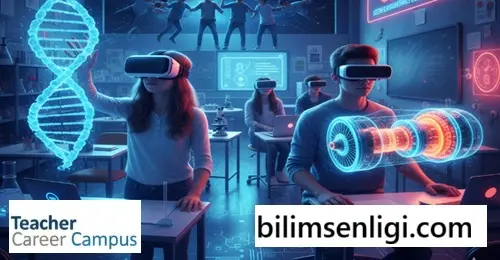
VR and AR revolutionize the way students experience content. Virtual Reality (VR) transports the user entirely into a computer-generated environment. Through a special headset (VR goggles), a student can find themselves safely conducting experiments in a chemistry lab, “strolling” inside a human heart, or inspecting the surface of Mars. This feeling of complete immersion significantly increases learning retention and depth.
On the other hand, Augmented Reality (AR) overlays digital information and objects onto the real world. Via a smartphone, tablet, or AR glasses, students can bring a three-dimensional geometric shape from their textbook to life on their desk, examine the layers of body systems on their own person, or observe the internal workings of a machine in its true size. AR provides immediate contextualization by making abstract information tangible.
Visualization of STEM Concepts: The Interdisciplinary Force (Approx. 350 words)
The greatest contribution of VR/AR to STEM education lies in its ability to transform abstract concepts into experiential content.
- Science: Experiments that would be dangerous or costly in chemistry classes can be performed repeatedly and safely in VR labs. In physics classes, students can personally experience the laws of motion in a zero-gravity environment through simulations. In biology, a virtual journey inside a DNA helix or observing a cell’s function up close ensures deep understanding rather than rote memorization.
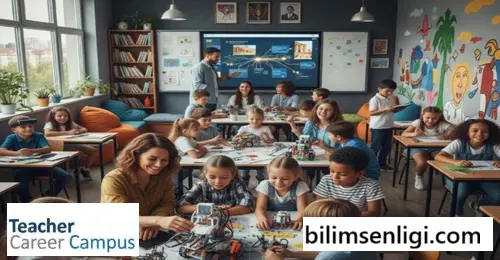
- Technology: Students can use AR to identify and inspect the parts of a complex machine or the components of a circuit board in real time. The logic of coding and algorithms becomes more engaging and understandable by programming virtual robots or visualizing algorithmic processes in the virtual world.
- Engineering: Design and modeling are at the core of engineering education. VR allows students to inspect the bridges, buildings, or vehicles they have designed by “stepping into them” in their real dimensions, detecting structural weaknesses early, and reducing the cost of prototyping to zero. AR, in turn, supports applied learning by overlaying maintenance or repair steps onto a real machine.
- Mathematics: Perhaps the most abstract discipline, mathematics becomes concrete with VR/AR. Three-dimensional graphs of functions can be explored in a virtual environment. Geometry concepts come alive through students’ interaction with virtual objects, calculating angles, volumes, and surface areas. Statistical data gains meaning through interactive data visualizations.
Practical Applications and Advantages for Educators and Teachers (Approx. 300 words)
VR/AR empowers not only students but also educators. The integration of these technologies into the classroom offers crucial advantages for maximizing learning outcomes:
- Motivation and Engagement: Interactive and immersive experiences dramatically increase students’ interest and motivation for the lesson. Learning transforms from an obligation into an enjoyable journey of discovery.
- Personalized Learning: VR/AR applications allow students to explore at their own pace. One student might repeat an expedition on Mars, while another might study nanotechnology-level structures in depth.
- Safe Experimentation Environments: They offer the possibility of conducting experiences that would be physically dangerous, ethically sensitive (e.g., surgical simulations), or physically impossible (e.g., seeing the beginning of the universe), in a safe virtual environment.
- Cost-Effectiveness: They present the potential to reduce education costs in the long term by decreasing the need for expensive laboratory equipment or field trips.
Teachers, by integrating these technologies into their existing lesson plans, gain the ability to present complex topics through visual storytelling. AR-based tasks transform traditional homework into practical, real-world-connected problems.
Conclusion and Future Perspective (Approx. 100 words)
Virtual and Augmented Reality are a powerful catalyst breaking down the walls of abstraction in STEM education. Thanks to their power of visualization, they are transforming not only what students learn, but also how they learn. It is vital for educators to adopt these technologies not as a luxury, but as an integral part of modern STEM pedagogy. With the proliferation of VR/AR, the next generation of scientists, engineers, and technology leaders will be fostered through experience, discovery, and ultimately, by changing the world. Welcome to this new era of visualization.