Although physics is the most fundamental science in our effort to understand how the universe works, it is often labeled as a “difficult” and “abstract” subject by students. Explaining concepts that are hard to observe with the naked eye, such as force, magnetic fields, quantum mechanics, or thermodynamics, on the board can sometimes be insufficient in the learning process. However, today, educational technologies, and especially Artificial Intelligence (AI)-supported tools, have become the greatest assistants to physics teachers in overcoming this difficulty.
In this guide, we will examine in detail the tools that you can use in a wide range, from simulating physical phenomena to solving complex mathematical problems, from virtualizing the laboratory environment to offering personalized learning experiences.
Making the Invisible Visible: Simulation and Visualization Tools
The cornerstone of physics education is to be able to create a correct model in the student’s mind. The following tools are designed to transform theoretical knowledge into an interactive experience.
- Algodoo: Creative Physics Sandbox Algodoo is not just simulation software, but also a 2D physics laboratory where students can use their imaginations. For teachers, Algodoo is the embodiment of the “Learning by Fun” (Gamification) concept. Students can set up their own gear systems, change friction coefficients, or study the behavior of objects in a gravity-free environment. Especially in mechanics and optics topics, it allows students to answer “What if it were like this?” questions by experiencing them instantly.
- PhET Interactive Simulations: Interactive World of Discovery PhET, developed by the University of Colorado, is one of the indispensable resources for physics teachers. It offers a very wide range of ready-made simulations from electrical circuits to quantum tunneling. The strongest aspect of PhET is that it transforms complex equations into visual models. When a student increases the resistance in a circuit, they can observe in real-time how the brightness of the bulb changes or how the voltage affects the current. This ensures that the logic is grasped rather than memorizing formulas.
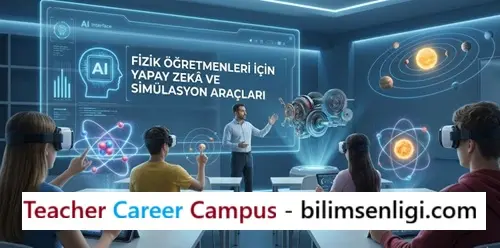
- PhysX and Virtual Physics Simulations: The Peak of Realism Although NVIDIA’s PhysX engine is generally known in the gaming world, it offers a “realistic physics” experience in education. Especially in topics such as particle dynamics and fluid mechanics, it offers industry-standard visualizations to students. On the other hand, Virtual Physics Simulations transforms the classroom into a laboratory using virtual reality (VR) and augmented reality (AR) technologies. Thanks to VR glasses or AR applications, students can study the planets revolving on their desks or take a journey inside an atom. This maximizes the student’s interest and focus on the lesson.
- Easy Java Simulations (EJS) For teachers who want their students to be not just consumers but also producers, EJS is an excellent tool. This Java-based system allows students to code and simulate their own physical models. This process enables the student to reconstruct the rules of physics with an algorithmic thinking structure, which is the key to deep learning.
Lightening the Burden of Mathematical Operations: Problem Solving Assistants
Physics uses a mathematical language, but sometimes students can drown in mathematical operations and miss the physical concept. These tools enable focusing on conceptual learning by lightening the processing burden.
- Wolfram Alpha: Knowledge Engine Wolfram Alpha is far beyond a classical calculator. A physics teacher can use Wolfram Alpha while explaining the solution of a complex wave equation to their students. The tool not only gives the result, but can also derive formulas, draw graphs instantly, and automatically include physical constants (e.g., Planck’s constant) in calculations. This is a critical tool for saving time in class and showing the “big picture”.
- Symbolab: Step-by-Step Learning One of the points where students have the most difficulty is following the solution path of a problem. Symbolab not only shows the result when solving math and physics problems, but also explains the path leading to the result “step by step”. This feature allows students to analyze where they made a mistake themselves and lightens the teacher’s individual feedback burden.
- PhysicsCalc This mobile-based application allows for quick calculations in basic topics such as kinematics, dynamics, energy, and momentum. It is a practical assistant that students can use while practicing or quickly confirming laboratory data.
Laboratory in Your Pocket: Data Collection and Analysis
The lack or expense of laboratory materials is no longer an obstacle. Thanks to smartphones and advanced software, every place can turn into a physics laboratory.
- Physics Toolbox Suite This application turns the sensors found inside smartphones (accelerometer, magnetometer, gyroscope, barometer, etc.) into data collection tools. A teacher can ask students to use their phones to measure the change in acceleration during the movement of an elevator or the magnetic field intensity of a magnet. Pouring the collected data into graphs instantly combines the theoretical graph reading skill with real-life data.
- LabVIEW: Experiment in Industrial Standards For more advanced high school or university-level education, LabVIEW provides a professional environment for modeling physical systems and processing sensor data. Students start their careers one step ahead by learning to collect and analyze data with this interface used by real engineers.
Personalized Learning and AI Instructors
Every student’s learning speed and the points where they get stuck are different. AI-supported tools support teachers in meeting these individual needs.
- Socrat AI and Physbot: 24/7 Question Solution Companions Socrat AI works with the Socratic method from which it takes its name. Instead of giving the answer directly to the student, it guides them to find the answer by asking thought-provoking questions. This develops the student’s critical thinking skill. Physbot, on the other hand, functions as a chatbot that answers students’ instant questions. These tools ensure that students maintain learning continuity by getting support on the topics they are stuck on outside of school hours.
- Isaac Physics and Khan Academy Physics Isaac Physics is an interactive problem-solving platform that adjusts the difficulty level according to the students’ level. It aims to correct misconceptions with the feedback it provides to students. Khan Academy, on the other hand, with its rich video library and step-by-step progressive structure, allows students to complete the topics they are lacking at their own pace. These platforms are ideal for teachers who want to implement the “Flipped Classroom” model.
Advanced Engineering and Modeling: For the Physicists of the Future
For teachers who want to combine physics education with engineering and advanced technology, the MATLAB and Simulink ecosystem comes into play.
- Simulink and MATLAB with AI Toolbox Simulink allows physical systems to be modeled via block diagrams. For example, the physics of a vehicle’s suspension system can be modeled here. MATLAB/Simulink with AI Toolbox takes the work one step further, teaching how artificial intelligence is used in the control of physical systems. This offers the opportunity to show students not only Newtonian physics, but also the working principles of modern autonomous systems.
Conclusion: Is the Teacher’s Role Changing?
None of these tools aims to replace the physics teacher; on the contrary, it elevates the teacher from the position of “knowledge transmitter” to the position of a guide who “designs and manages the learning process”.
A teacher who visualizes the lesson with Algodoo or PhET, encourages students to research with Physics Toolbox, gets rid of the burden of mathematics with Wolfram Alpha and focuses on the logic of physics, and can show special attention to each student with Socrat AI, will raise individuals with 21st-century competencies.
Thanks to these artificial intelligence and simulation tools, physics education is no longer a boring process where formulas are memorized; it is turning into an exciting adventure where the secrets of the universe are discovered.