Introduction: Why Girls Need STEM, and Why STEM Needs Girls
The fields of STEM (Science, Technology, Engineering, and Mathematics) are the main drivers of economic and social development in our era and the future. However, female representation in these critical areas still falls far short of its potential. Data shows that female students’ interest in these disciplines declines as they progress to secondary and university levels. This situation is not only a loss from the perspective of gender equality but also a huge loss for global innovation and competitiveness.
As educators and teachers, we have a pivotal role in bridging this gap. Our classroom practices, guidance approaches, and the school culture we establish can ignite girls’ interest in STEM and solidify their success. This article presents evidence-based and actionable strategies for increasing the participation and achievement of girls in STEM education.
I. Early Intervention and Awareness Building
Interest in STEM fields begins to take shape at an early age. The correct steps taken at the primary school level directly influence their career choices in high school and beyond.
1. Fun, Experiment-Oriented Learning
We must prevent female students from viewing STEM as merely a collection of abstract formulas.
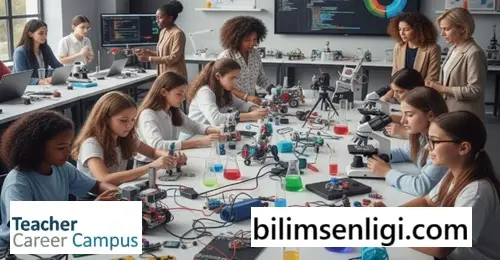
- Play and Exploration: Place simple science experiments, coding games, and math puzzles at the center of lessons. Ensure that students learn by doing, touching, and exploring.
- Contextualization: Show how the science and math concepts being taught contribute to solving everyday problems or environmental issues around them. For example, emphasize the role of mathematical ratios in architecture or scientific principles in addressing pollution.
2. Introducing the Engineering Design Process
Engineering is often perceived as a male domain. To break this stereotype, we must teach all students the engineering design process (defining the problem, brainstorming, building the prototype, testing, refining) at an early age and through hands-on application. This process encourages creativity, problem-solving skills, and collaboration.
II. In-Class Pedagogical Strategies
Teachers’ interactions in the classroom and their choice of materials are vital for female students to feel comfortable and competent in the STEM environment.
1. The Power and Visibility of Role Models
When female students see successful women scientists and engineers of their own gender, they understand that these fields are also open to them.
- Historical and Contemporary Female Figures: In teaching materials and class discussions, include not only male scientists but also Marie Curie, Ada Lovelace, Hedy Lamarr, or successful contemporary female engineers and programmers.
- Guest Speakers and Mentorship: Invite female professionals with STEM careers to the school or virtual environment. Provide opportunities for female students to interact directly and receive mentorship from these role models. This will show them concrete examples of their career paths.
2. Collaborative and Inclusive Learning Environments
Female students often feel more successful and comfortable in collaborative settings.
- Teamwork: During Project-Based Learning (PBL) and team work, ensure that groups are balanced and encourage every girl to take on an active leadership or critical role.
- Fostering a “Growth Mindset”: Emphasize that making mistakes is a natural part of the learning process. Promote a “Growth Mindset” which teaches that intelligence and ability are not fixed, but develop through effort and perseverance. This will reduce the tendency of girls to give up when faced with challenging STEM topics.
3. Using Gender-Neutral Language and Visual Materials
The language used by teachers and the visuals they present profoundly influence students’ perceptions.
- Avoiding Stereotypes: In math or science classes, use inclusive, gender-neutral language, rather than generalized phrases such as “Engineers do this.”
- Visual Representation: Use images on classroom boards, presentations, and worksheets that show women and men equally represented in STEM professions.
III. Building Confidence and Self-Efficacy
Belief in self-efficacy—the personal conviction of being able to successfully perform a task—is one of the most important factors that trigger success.
1. Highlighting Achievement and Constructive Feedback
Publicly acknowledge the achievements of female students in STEM fields. When giving feedback, especially when they solve a complex problem or develop a creative design, emphasize their effort, strategies, and capabilities. Instead of saying, “You are very smart,” give more specific feedback, such as, “Your analytical thinking ability that you used to solve this problem is fantastic.”
2. Spatial Skills Development Activities
Spatial reasoning skills (e.g., mentally rotating an object or inferring a 3D object from a 2D drawing) are crucial in engineering and physics, and girls may be less encouraged to develop these skills than boys at an early age. Focus on strengthening these skills with puzzles, Legos, 3D modeling software, and geometry activities.
IV. School and Community-Level Support
STEM success should not be limited to the classroom; it should be supported by school administration and community collaboration.
1. Girls-Only STEM Clubs and Workshops
After-school STEM clubs exclusively for female students can make them feel safer and less hesitant to take risks. These clubs can focus on topics such as coding, robotics, or environmental engineering.
2. Family Involvement and Information
Families can be very influential in their daughters’ career choices. Teachers should sensitize parents by organizing seminars or information sessions that present career opportunities in STEM and the capabilities of their daughters. It is crucial to ensure that families support their daughters’ participation in STEM activities.
Conclusion: Shaping the Leaders of Tomorrow
Increasing female students’ interest and success through STEM education requires much more than simply changing the content of a lesson. It requires us to rethink our classroom culture, our pedagogical approaches, and our stance against gender biases.
As educators, we must ensure that every female student sees the bright future she can have in science, technology, engineering, or mathematics. With strategies to awaken early interest, provide positive role models, create an inclusive learning environment, and support self-efficacy, we will not only increase individual success but also cultivate a diverse and strong scientific workforce that will offer creative solutions to the global challenges of the future. Unleashing the potential of our girls is the responsibility of us all.