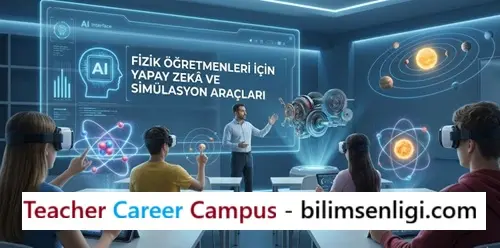
The dizzying pace of the global economy and technological progress is fundamentally changing expectations from education systems. We no longer just need individuals who memorize information, but individuals who can apply knowledge, solve complex problems, think critically, and collaborate. This is where STEM education comes in, bringing together the disciplines of Science, Technology, Engineering, and Mathematics.
STEM education views these four areas not as separate islands, but connects them with a strong bridge, enabling students to approach real-world issues with a holistic perspective. The core focus of this article is how to effectively integrate the two most critical pillars of this bridge, Science and Mathematics, into lesson plans, thereby creating original lessons that support both meaningful learning and 21st-century skills.
Why Integrate? “How Do Science and Mathematics Unite?”
In the traditional educational approach, Science is learned in the laboratory, and Mathematics is taught with formulas on the blackboard. But in real life, no problem—whether it is the statics of a skyscraper, the development of a vaccine, or the modeling of climate change—is confined within the borders of a single discipline. Science (physics, chemistry, biology) enables us to understand and observe the world, while Mathematics provides the universal language and toolset necessary to measure, model, predict, and prove the accuracy of these observations.
Effective STEM lesson plans integrate Science and Mathematics through the following ways:
- Providing Context: Mathematical concepts (ratio, graph, function) move out of abstraction and come to life with the concrete data from science experiments or engineering projects. For example, when learning concepts of acceleration and force in a rocket launch experiment, algebra and trigonometry are used to calculate these values.
- Problem-Solving: Solving real-world problems (such as designing a water purification system) requires both scientific principles (chemistry, biology) and mathematical skills like measurement, data analysis, and optimization.
- Deep Understanding: It is ensured that the student simultaneously finds answers to the question of “why” (Science) and the question of “how much” or “how to calculate” (Mathematics). This dual approach increases the retention of knowledge.
The Fundamental Pillars of Effective STEM Lesson Plans
When preparing a lesson plan that integrates Science and Mathematics, there are three main components that must be centered:
1. Real-World Problem and Context:
The starting point of the lesson plan should be the definition of a problem that will attract students’ interest, whether it is local or global. This problem must necessitate the use of tools from both Science (observation, hypothesis) and Mathematics (data collection, modeling). For example: Investigating the causes of the decline in the bird population in the neighborhood (Biology), and mathematically modeling and predicting this decline (Statistics, Functions).
2. The Engineering Design Process (EDP):
STEM is completed with the T and E components. The Engineering Design Process (EDP) is a cyclical process where students use their Science and Mathematics knowledge to define problems, create a solution draft, develop a prototype, test it, and improve it. This process should form the backbone of the lesson plan.
- Definition: Determining the scientific and mathematical dimensions of the problem.
- Research/Development: Learning the necessary scientific principles and mathematical formulas.
- Design and Construction: Building a solution prototype based on mathematical calculations (size, cost, durability).
- Testing and Evaluation: Analyzing the results of the prototype tested with scientific methods using mathematical data.
3. Open-Ended and Collaborative Learning:
An effective STEM class means that students are active participants, not passive recipients. Lesson plans should be student-centered; they must allow for discussion, group work, and different paths to a solution.
Steps to Realize Integration: Building the Bridge
As educators, the following systematic steps should be followed when preparing lesson plans that integrate Science and Mathematics:
Step 1: Determine Interdisciplinary Goals
First, it should be identified which learning outcomes in both the Science and Mathematics curricula can be integrated around the identified real-world problem.
- Example Science Goal: Explaining the forces that keep a structure in equilibrium (Physics).
- Example Mathematics Goal: Using the similarity of triangles and the Pythagorean theorem to calculate slope and tension.
Step 2: Select Materials and Resources
The lesson plan should include tools that allow students to conduct both science experiments (sensors, laboratory materials) and mathematical modeling (graphical software, electronic spreadsheets). For the provision of the Technology (T) and Engineering (E) components in integrated lessons, low-cost materials (cardboard, sticks, recycled materials) and digital tools (simulations, coding) are of crucial importance.
Step 3: Structuring and Process of the Activity
The flow of the lesson should follow the steps of the EDP. For example, for a 4-week project:
- Week 1: Problem Understanding and Scientific Investigation (Science-focused: hypothesis building, experiment design).
- Week 2: Mathematical Modeling and Calculation (Mathematics-focused: data collection, regression, optimization).
- Week 3: Design and Prototype Construction (Engineering-focused: application, testing).
- Week 4: Presentation, Analysis, and Improvement (Joint evaluation of Science and Mathematics results).
Step 4: Using Original Assessment Methods
Traditional exams are insufficient to measure integrated learning. In effective STEM lesson plans, the assessment process should also be interdisciplinary:
- Project Assessment Rubrics: Rubrics that measure both scientific process skills (experiment report, data interpretation) and mathematical accuracy and modeling capability.
- Peer Assessment: Evaluation by students of each other’s designs according to scientific and mathematical criteria.
- Portfolio: Presentation by the student of all their calculations, drawings, and prototype phases carried out throughout the process.
Challenges of Building the Bridge and Solutions
Creating lesson plans that integrate Science and Mathematics can bring some challenges for educators:
| Challenge | Suggested Solution |
| Time Constraint: Fitting comprehensive projects into the curriculum. | Creating flexible time slots between classes for topic integration and forming thematic units that cover the basic subjects. |
| Teacher Training: Lack of interdisciplinary knowledge and pedagogical skills. | Organizing training and workshops that encourage collaboration between specialized Science and Mathematics teachers. |
| Lack of Materials and Resources: Difficulty in accessing the tools and equipment required for project-based learning. | Using low-cost solutions (recyclable materials) and transforming schools’ science/computer laboratories into shared usage areas. |
| Difficulty in Assessment: Concern about objectively measuring integrated skills. | Using predetermined, detailed rubrics and performance tasks that cover interdisciplinary competencies. |
Conclusion: Educators Who Shape the Future
Creating effective STEM lesson plans that unite Science and Mathematics is much more than just delivering the curriculum; it is presenting a vision for nurturing the problem-solvers of the future. The educators who build this bridge teach students not only to observe the world but also to analyze it with mathematical precision and improve it using scientific principles.
As we strengthen the bridge between Science and Mathematics, our students’ ability to transform abstract concepts into concrete success will increase, and thus, all of us as educators will witness the power of this new generation to cope with global challenges. The key to successful STEM education is to remove the boundaries of disciplines at the planning stage and to look at every topic through a holistic, discovery-open window.